
Herbalife24 Creatine+: The Science of Creatine and What’s in This Formula
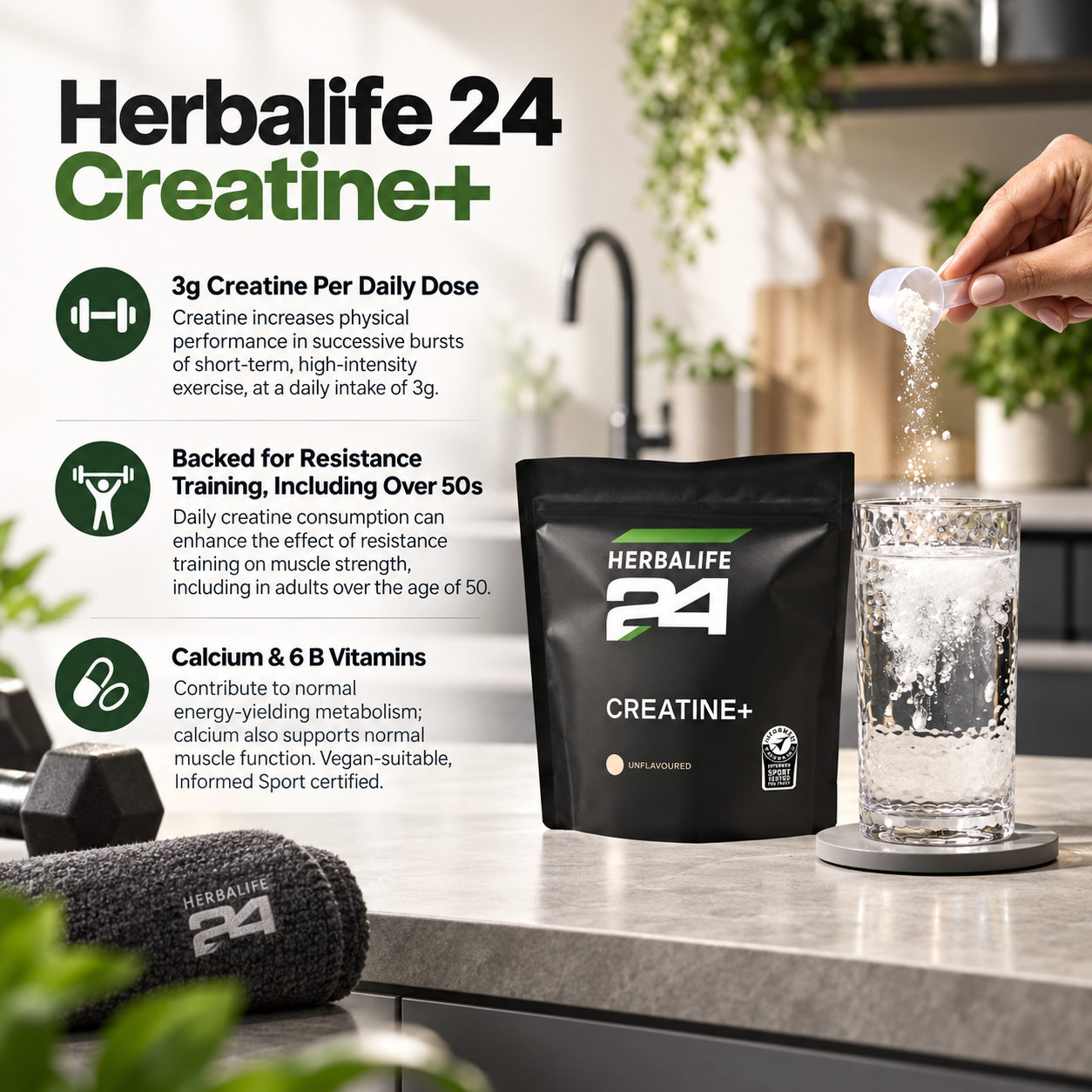
Herbalife24 Creatine+ is an unflavoured, vegan-suitable creatine monohydrate powder providing 3g of creatine per 3.8g daily dose, formulated with added calcium and B vitamins (B1, B2, B6, B12, niacin, pantothenic acid). It’s Informed Sport certified and manufactured by Aminolabs Deutschland GmbH, Bleckede, Germany.
This guide covers how creatine works in the body, exactly what the EU-authorised claims say (including a specific age detail worth getting right), and the product’s full label data.
Quick Summary
- 3g of creatine per daily dose (3.8g of creatine monohydrate) — the exact amount the EU-authorised performance claim requires.
- Authorised claim: creatine increases physical performance in successive bursts of short-term, high-intensity exercise, at a daily intake of 3g.
- Separate authorised claim: daily creatine, combined with resistance training, can enhance the effect of that training on muscle strength — the underlying EFSA opinion specifies adults over the age of 55 (Herbalife’s own product description says “over 50” — see the note below).
- Also contains: 146mg calcium (18% RI) and six B vitamins, contributing to normal energy-yielding metabolism.
- Vegan and vegetarian suitable by ingredients (creatine monohydrate, calcium carbonate, synthetic vitamins) — separately, research shows vegetarians tend to have lower dietary creatine intake, since food-derived creatine comes mainly from meat and fish.
- Informed Sport certified. Scoop not included — sold separately.
On this page
- How Creatine Works in the Body
- What the EU-Authorised Claims Actually Say
- Creatine and Vegetarian or Vegan Diets
- Creatine and Cognitive Research
- Full Nutritional Information
- How to Use Herbalife24 Creatine+
- Informed Sport Certification
- Ingredients and Allergens
- Pairing With Other Herbalife24 Products
- Frequently Asked Questions
- Sources & References
How Creatine Works in the Body
Creatine is a naturally occurring compound involved in rapid energy production in muscle cells. Around 95% of the body’s creatine is stored in skeletal muscle, largely as phosphocreatine. During short, intense bursts of activity, phosphocreatine donates a phosphate group to help regenerate ATP (adenosine triphosphate, the molecule cells use directly for energy) faster than the body could otherwise manage. This is why creatine’s authorised benefit is specifically tied to short-term, high-intensity, repeated exercise, rather than steady low-intensity activity.
What the EU-Authorised Claims Actually Say
Two separate EFSA opinions underpin the claims associated with creatine, and they apply to different things.
Claim 1 — Physical performance: creatine increases physical performance in successive bursts of short-term, high-intensity exercise. The beneficial effect is obtained with a daily intake of 3g of creatine (EFSA Journal 2011;9(7):2303).
Claim 2 — Muscle strength with resistance training: daily creatine consumption, combined with resistance training, can enhance the effect of that training on muscle strength. The EFSA opinion authorising this claim specifies adults over the age of 55, taking at least 3g/day alongside regular resistance training (three times a week, for several weeks).
A note on the age detail: Herbalife’s own product description for Creatine+ states this benefit applies “in adults over the age of 50.” The underlying EFSA opinion that authorises the claim specifies adults over the age of 55. Both figures are given here with their source — this kind of detail is worth being precise about rather than smoothing over.
Creatine and Vegetarian or Vegan Diets
Dietary creatine comes almost entirely from meat and fish; plant foods contain negligible amounts. Research comparing vegetarians to omnivores has found lower baseline muscle creatine stores in vegetarians (Burke et al., 2003, Medicine & Science in Sports & Exercise), and a systematic review has examined the broader implications of a vegetarian diet for creatine and carnosine pools (Blancquaert et al., 2018, British Journal of Nutrition).
Separately from that background research, Herbalife24 Creatine+ itself is formulated from creatine monohydrate, calcium carbonate and synthetic vitamins — none of its ingredients are animal-derived, making the product itself suitable for vegetarians and vegans.
Creatine and Cognitive Research
A growing body of research is examining whether creatine affects brain function, since neurons also rely on ATP and the brain is a metabolically demanding organ. This is an active but early area of study — Herbalife’s own product description states that further research is needed before definitive conclusions or formal health claims can be made about creatine and mental health, and this article takes the same position: this is a research direction worth watching, not an established or authorised benefit of this product.
Full Nutritional Information
Per daily dose (3.8g), as stated on the official UK label.
| Nutrient | Amount | % RI |
|---|---|---|
| Thiamin | 0.18mg | 16% |
| Riboflavin | 0.21mg | 15% |
| Niacin | 2.4mg NE | 15% |
| Vitamin B6 | 0.21mg | 15% |
| Vitamin B12 | 0.38µg | 15% |
| Pantothenic acid | 0.90mg | 15% |
| Calcium | 146mg | 18% |
| Creatine monohydrate | 3.4g | — |
| of which Creatine | 3.0g | — |
How to Use Herbalife24 Creatine+
Mix approximately 3.8g (2 x 3cc scoops) with 200ml of water, or add it to a daily shake. It can be taken once a day, at any time — before, during, or after a workout, and on rest days too, since creatine works through cumulative saturation rather than an immediate stimulant effect. For the product to become fully effective, the label recommends daily use of approximately 3.8g for at least 28 days. A scoop is not included in the tub and is sold separately (SKU 9B48, 2 x 3cc scoops).
Informed Sport Certification
Herbalife24 Creatine+ is Informed Sport certified. A sample of each batch is tested by LGC’s sports anti-doping laboratory and confirmed free of banned substances in its anti-doping screen.
Ingredients and Allergens
Creatine monohydrate, calcium carbonate, Niacin (nicotinamide), Pantothenic acid (calcium D-pantothenate), Vitamin B12 (cyanocobalamin), Thiamin (thiamin hydrochloride), Vitamin B6 (pyridoxine hydrochloride), Riboflavin.
May contain soy, milk and eggs (cross-contact warning; not a deliberate ingredient).
Pairing With Other Herbalife24 Products
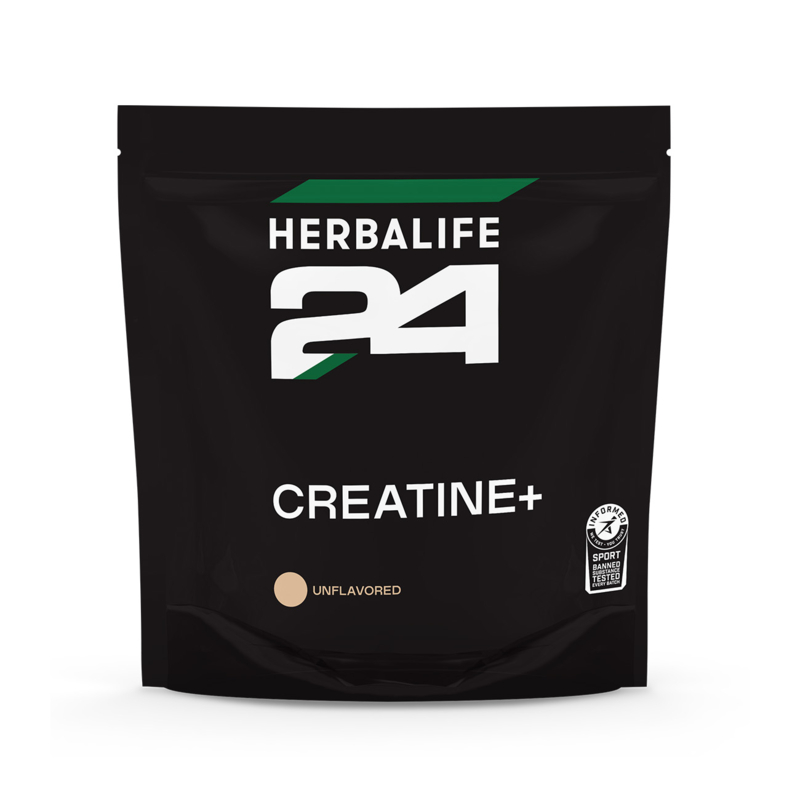
Herbalife24 Creatine+
3g creatine, calcium and B vitamins per daily dose. Informed Sport certified. Net weight 228g.
View Product →Frequently Asked Questions
Should I take Herbalife24 Creatine+ before or after workouts?
Timing doesn’t appear to matter much — it can be taken anytime, once a day, before, during or after a workout.
Do I need to do a loading phase?
No. The standard 3.8g daily serving reaches full saturation within about 28 days without a separate loading phase.
Can I take it on rest days?
Yes. The label recommends daily use, including on non-training days, at approximately 3.8g.
Is Herbalife24 Creatine+ vegan?
Yes, by ingredients — creatine monohydrate, calcium carbonate and synthetic vitamins are all non-animal. The label carries a “may contain soy, milk and eggs” cross-contact warning.
Does creatine cause water retention?
Herbalife’s own product materials don’t make specific claims about water retention. If this is a concern, it’s worth discussing with a healthcare professional or personal trainer familiar with your training.
Are there known side effects?
Herbalife’s own reference material states no significant adverse effects are known, though the body may need time to adjust when starting.
Sources & References
- EFSA Panel on Dietetic Products, Nutrition and Allergies (NDA). Scientific Opinion on the substantiation of health claims related to creatine and increase in physical performance during short-term, high intensity, repeated exercise bouts. EFSA Journal 2011;9(7):2303.
- EFSA NDA Panel. Creatine in combination with resistance training and improvement in muscle strength: evaluation of a health claim. EFSA Journal (adults over 55).
- Burke DG, et al. Effect of creatine and weight-training on muscle creatine and performance in vegetarians. Medicine & Science in Sports & Exercise. 2003;35(11):1946-55.
- Blancquaert L, et al. Changing to a vegetarian diet: is it harmful to muscle carnosine and creatine pools? British Journal of Nutrition. 2018;119(7):759-70.
- Kreider RB, et al. International Society of Sports Nutrition position stand: safety and efficacy of creatine supplementation in exercise, sport, and medicine. Journal of the International Society of Sports Nutrition. 2017;14(1):18.
- Additional studies referenced by Herbalife’s own product documentation: Herda TJ, et al. J Strength Cond Res. 2009;23(3):818-26; Kaviani M, et al. J Sports Med Phys Fitness. 2019;59(4):608-12; Shao A, Hathcock JN. Regulatory Toxicology and Pharmacology. 2006;45(3):242-51; Kreider RB, et al. Nutrients. 2022;14(5); Hultman E, et al. J Appl Physiol. 1996;81(1):232-7; Steenge GR, et al. J Appl Physiol. 2000;89(3):1165-71; Green AL, et al. Am J Physiol. 1996;271(5 Pt 1):E821-6. (Listed as cited by Herbalife’s official reference list; not independently re-verified link-by-link in this revision.)
- Nutritional and ingredient data as disclosed on the official Herbalife24 Creatine+ UK product label.
Want More Herbalife Guides Like This?
Explore the full library of UK product guides, comparisons and how-tos.
Browse All Articles →