
AloeMax: A Science-Based Guide to 97% Cold-Pressed Aloe Vera Juice
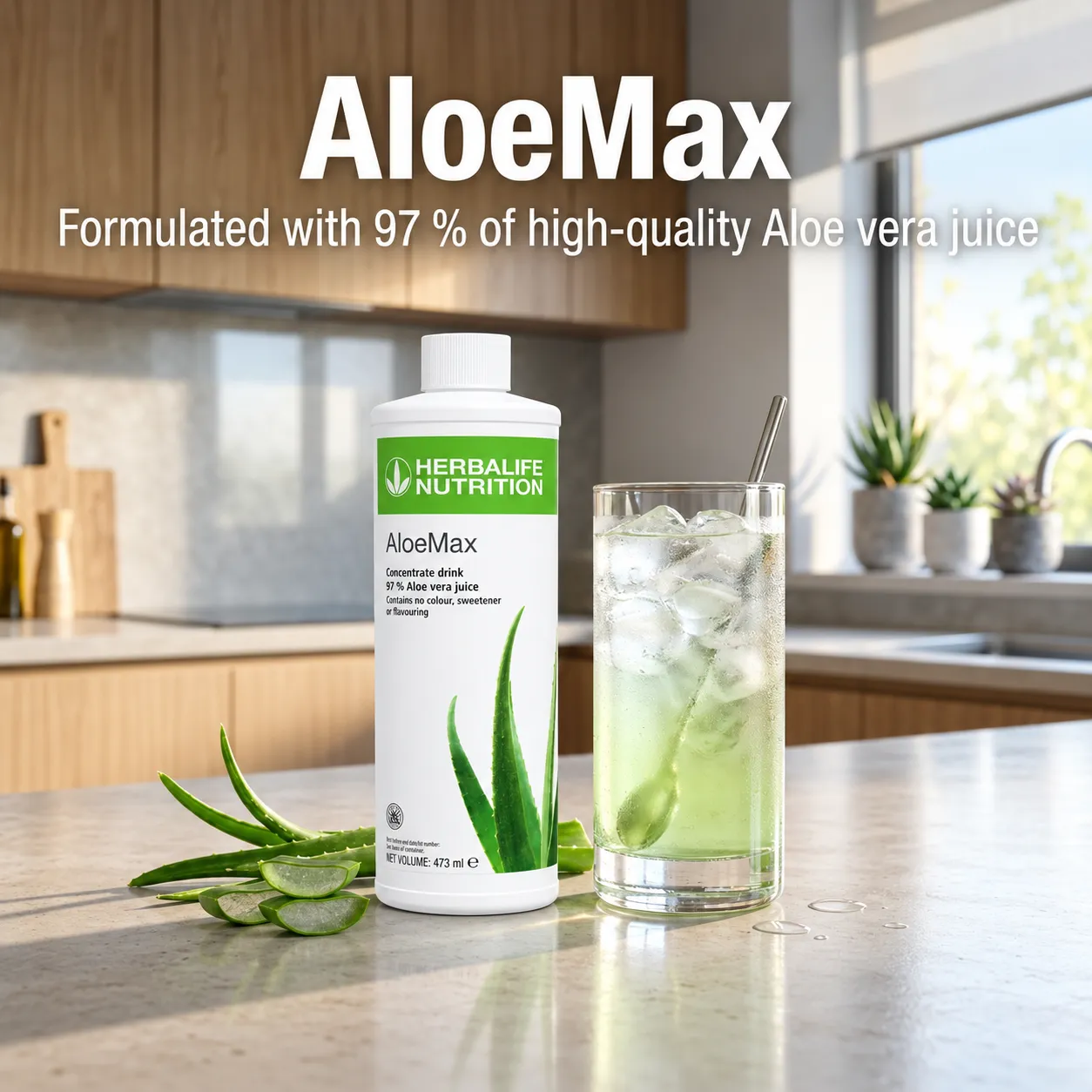
AloeMax is Herbalife’s 97% cold-pressed Aloe vera concentrate, made from the whole leaf and certified by the International Aloe Science Council (IASC). This guide looks at what “97% cold-pressed” and “whole leaf” actually mean, why third-party certification matters for an aloe product, and how to prepare and store it correctly.
Quick Summary
- What it is: A 473ml concentrate containing 97% cold-pressed Aloe vera juice from the whole leaf, plus chamomile extract.
- Certification: Meets International Aloe Science Council (IASC) purity and authenticity standards, as stated on the product label.
- Per serving (15ml): 2 calories, no added colours, sweeteners or flavours.
- Servings per bottle: 31 (3 capfuls / 15ml each).
- How to use: Mix 3 capfuls (15ml) with 120ml water, or 120ml with 1 litre of water for all-day hydration.
- Storage: Refrigerate after opening; use within 30 days.
On this page
What Is AloeMax?
AloeMax is a concentrated Aloe vera drink mix containing 97% cold-pressed juice derived from the whole leaf of Aloe barbadensis, with chamomile extract added and no colours, sweeteners or flavours. It’s designed to be diluted with water rather than drunk directly, and is certified by the International Aloe Science Council (IASC) — an industry body that verifies aloe content and purity.
It differs from Herbalife’s flavoured Herbal Aloe Concentrate range (such as the Mango variant) mainly in concentration and additive profile — more on that comparison below.
Whole Leaf Processing & the 97% Standard
Aloe products are typically made from either the inner gel alone, or the whole leaf, which includes the gel plus material closer to the outer rind. The important distinction isn’t that the rind is a hidden source of extra nutrients — it’s that the layer near the rind contains latex with compounds called anthraquinones (including aloin), which have a laxative effect and can cause gastrointestinal irritation at higher concentrations. Reputable whole-leaf processing, including the standard AloeMax is certified against, is built around carefully filtering this latex out while retaining the beneficial inner-leaf polysaccharides — rather than simply including more of the rind.
Cold-pressing (as opposed to heat-based extraction) is used because some of the aloe polysaccharides thought to be biologically relevant — including acemannan — are heat-sensitive and can be degraded by high-temperature processing.
What “97% cold-pressed” means in practice: the remaining ~3% is typically water and minor processing components. It doesn’t mean the product is 97% “pure aloe gel” in a lab-isolate sense — it reflects the proportion of cold-pressed aloe juice in the final formulation, which is a genuinely high concentration compared with heavily diluted retail aloe drinks.
IASC Certification Explained
The International Aloe Science Council (IASC) is an industry body that certifies aloe vera raw materials and finished products against standards for authenticity and purity — including that the product genuinely contains the aloe vera content stated on the label, and that anthraquinone/aloin levels are controlled to recognised limits. AloeMax’s IASC certification is stated on its official product label and page; it is a manufacturer-and-industry-body verification rather than an independently published clinical study, and is presented here on that basis.
Aloe Polysaccharides & Chamomile
The primary polysaccharide of interest in Aloe vera gel is acemannan. A 2021 pharmacology review in Phytotherapy Research summarised evidence that dietary acemannan may support digestive processes and interact with immune signalling pathways, while noting that — due to mixed results across studies — further research is still needed to confirm the extent of these effects in humans.1 This is a fair, current summary of where the science stands: promising mechanistic evidence, not yet a settled clinical conclusion.
Chamomile (Matricaria chamomilla) has a long history of traditional use for digestive comfort, and a 2016 systematic review of chamomile’s therapeutic effects found supporting evidence for antispasmodic and gastrointestinal-soothing properties across the studies it examined.2 Its inclusion in AloeMax reflects this traditional and researched use, alongside the aloe base.
AloeMax vs. Herbal Aloe Concentrate (Mango)
Within Herbalife’s range, the two most comparable aloe products are AloeMax and the flavoured Herbal Aloe Concentrate (available in Mango and other flavours). Both are diluted with water, but they serve slightly different purposes:
| Feature | AloeMax | Herbal Aloe Concentrate (Mango) |
|---|---|---|
| Aloe concentration | 97% cold-pressed | 40% cold-pressed |
| Flavour | None (unflavoured) | Mango |
| Calories per serving | 2 kcal (15ml) | 2 kcal (15ml) |
| Best for | Purists / unflavoured daily use | Those who prefer a flavoured drink |
Neither is “better” in an absolute sense — AloeMax suits people who want the highest aloe concentration with zero additives, while the Mango variant suits those who prefer a flavoured everyday drink. Both are sugar-free and low in calories.
Compared with many mass-market retail aloe drinks — which are often heavily diluted with water and sweeteners — a 97% concentrate like AloeMax represents a meaningfully higher aloe content, though exact concentrations vary by brand and aren’t something we can verify for products we don’t sell.
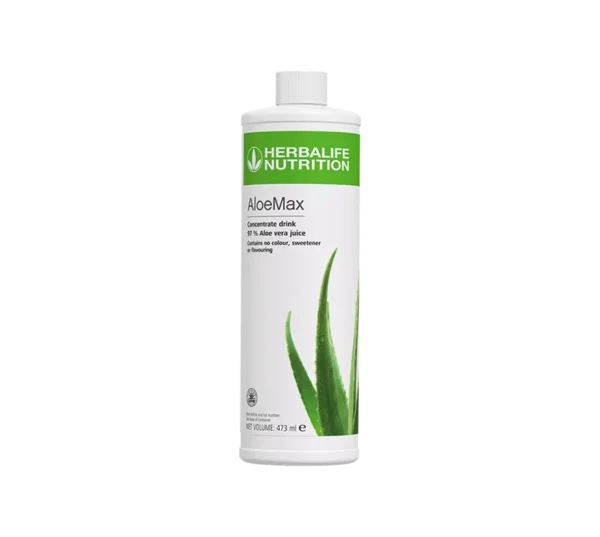
Herbalife AloeMax — 473 mL
97% cold-pressed whole-leaf aloe vera juice with chamomile extract. IASC-certified, no colours, sweeteners or flavours. 31 servings.
- 2 kcal / serving
- IASC certified
- Vegan & vegetarian
How to Prepare & Store It
- Shake well: Always shake the bottle before use so the chamomile extract and aloe polysaccharides are evenly distributed.
- Single serving: Mix 3 capfuls (15ml) with 120ml of water.
- Daily hydration jug: Mix 120ml of AloeMax with 1 litre of water for all-day sipping.
- Serve cold or room temperature: Very hot water isn’t recommended, as high heat can degrade some of the heat-sensitive aloe compounds preserved by cold-pressing.
- After opening: Refrigerate and consume within 30 days. Unopened bottles should be stored in a cool, dry place away from direct sunlight.
Related Reading
Frequently Asked Questions
What’s the difference between AloeMax and the Mango Herbal Aloe Concentrate?
AloeMax is a higher concentration (97% cold-pressed juice) and completely unflavoured with no added colours or sweeteners. The Mango variant is a lower concentration (40%) formulated for flavour and everyday drinking preference. Both are low-calorie and sugar-free.
Is AloeMax beneficial for digestion?
AloeMax is derived from the whole leaf and contains aloe polysaccharides, including acemannan, which have been studied for potential digestive and immune-related effects — though current research is still developing rather than fully conclusive. The added chamomile extract has separately researched traditional use for digestive comfort.
Is it suitable for vegetarians and vegans?
Yes, AloeMax is suitable for both vegetarians and vegans and contains no animal-derived ingredients.
What does the IASC certification actually mean?
The International Aloe Science Council (IASC) verifies that a product contains genuine, authenticated aloe vera at the stated concentration and that it meets recognised purity standards, including controls on aloin/anthraquinone content. It’s a manufacturer-and-industry certification stated on the product label.
How long does a bottle last after opening?
A 473ml bottle contains 31 servings (15ml each). Once opened, refrigerate and consume within 30 days.
Can I mix AloeMax with hot drinks or tea?
It’s best mixed with cold or room-temperature water. Very high heat can degrade some of the heat-sensitive compounds preserved by the cold-pressing process, so hot water isn’t recommended.
Sources & References
- Sierra-García GD, et al. Pharmacodynamics of Aloe vera and acemannan in therapeutic applications for skin, digestion, and immunomodulation. Phytotherapy Research. 2021;35(12):6572-6584. PubMed
- Miraj S, Alesaeidi S. A systematic review study of therapeutic effects of Matricaria recuitta chamomile (chamomile). Electron Physician. 2016;8(9):3024-3031. PubMed
- Hamman JH. Composition and Applications of Aloe vera Leaf Gel. Molecules. 2008;13(8):1599-1616. PubMed
- Product specification, IASC certification statement and nutrition data as disclosed on the official AloeMax product page.